
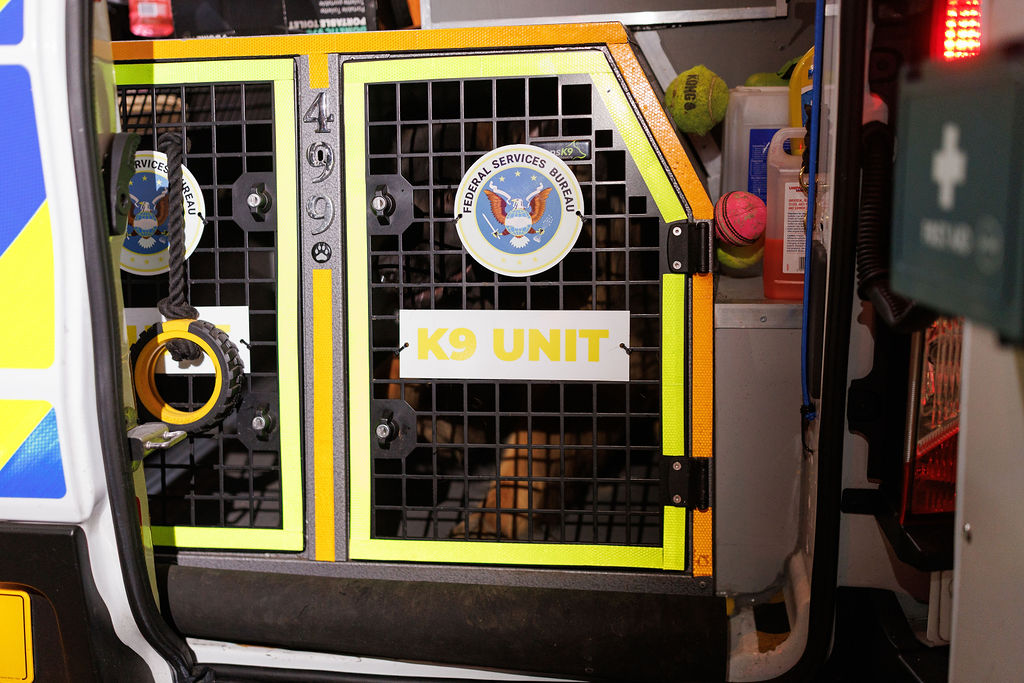
You might not see the security dog. That does not mean it is not ready.
Effective security is often about creating a situation in which an intruder decides not to proceed in the first place. For properties and sites requiring an enhanced level of protection, professional K9 Security in London can provide a powerful combination of detection, deterrence and trained human judgement.
FSB_London provides professional K9 Dog Services, pairing trained security dogs with professional handlers to support the protection of premises and sites across London. The security dog and handler operate as a team, combining the dog’s sensory capabilities and visible presence with the handler’s assessment, communication and security experience.
This combination can strengthen patrol operations, help identify unauthorised activity and provide a significant visual deterrent. Specialist canine patrols are designed to detect, deter and respond to potential security concerns, with dogs working alongside trained security handlers.
For businesses, vacant properties and other locations where conventional security measures may benefit from additional support, a professionally deployed K9 team can become an important part of a wider security strategy.
What Is K9 Security?
K9 security uses trained security dogs working under the control of professional handlers to support security operations.
The important element is the team.
A professional K9 security service is not simply the presence of a dog. The effectiveness of the deployment depends on the relationship between the handler and dog, appropriate training, operational procedures, site knowledge and the ability of the handler to interpret the dog’s behaviour and make proportionate security decisions.
Dogs possess sensory capabilities that can provide an additional dimension to conventional security patrols. FSB_London K9 Dog Services use these capabilities to support the detection of potential intruders while giving handlers additional awareness when assessing a developing situation.
The result is a security presence that combines human judgement with canine awareness.
Why Use K9 Security in London?
London contains an enormous variety of commercial, residential, industrial and temporary environments. Security requirements can differ considerably between a busy operational building and an empty property, or between a compact commercial premises and a larger site with extensive boundaries.
Where a risk assessment identifies a suitable requirement, K9 Security London services can strengthen conventional guarding by introducing both an additional detection capability and a highly visible deterrent.
A potential trespasser may be prepared to test a fence, gate or conventional security arrangement. The knowledge that a trained security dog and professional handler are patrolling the premises can significantly change that calculation.
This is one of the principal strengths of security dog patrols. Their value is not limited to responding after an intrusion has occurred. A professional K9 presence is also designed to discourage unauthorised access before an incident develops.
The Power of Visible Deterrence
Deterrence is a fundamental part of effective security.
The objective should not always be to catch somebody committing an offence. Where possible, security should make the premises less attractive to unauthorised individuals in the first place.
A professional security dog creates a distinctive and recognisable presence. Combined with a trained handler, patrol routines and wider security measures, that presence can communicate that the site is actively protected.
FSB_London K9 Dog Services use this visible presence alongside the sensory capabilities of trained security dogs to support professional patrol operations.
This can be particularly valuable in environments where there are larger external areas, multiple access points or periods when fewer authorised personnel are present.
The principle is straightforward. If a potential intruder believes entering a site will be difficult and carries a greater likelihood of detection, the deterrent value of the security operation increases.
Security Dogs and Intruder Detection
Visual deterrence is only part of the value of a professional K9 team.
Dogs have sensory perception that can support handlers during patrols, particularly when assessing environments where visibility or physical layout may make conventional observation more difficult.
FSB_London K9 Dog Services use trained dogs to support the identification of potential intruders. Additional awareness can give the handler more opportunity to assess the circumstances, follow established procedures and determine whether further action or support is required.
This does not replace professional human judgement. It strengthens it.
The handler remains responsible for assessing the situation and operating according to the agreed security procedures for the site.
That relationship between canine capability and professional human judgement is central to K9 security.
A Security Dog and Handler Work as One Team
The image of a security dog working independently can create the wrong impression of professional K9 operations.
FSB_London deploys security dogs as part of a handler-and-dog team. Each dog works alongside a trained security handler, with the team introduced to the site and incorporated into the agreed patrol operation.
The handler provides control, judgement and communication. The dog provides additional sensory awareness and a strong deterrent presence.
Neither element should be considered in isolation.
Professional handlers need to understand the site, patrol expectations, relevant higher-risk areas and procedures for reporting or escalating incidents. They also need to maintain effective control of the dog throughout the deployment.
This structured approach differentiates professional K9 Dog Services from simply having a dog present on a property.
How FSB_London Plans a K9 Security Deployment
Effective K9 security begins with understanding the premises.
A security strategy that works for one site cannot simply be copied onto another. Site layout, access points, boundaries, operating hours and areas of particular concern can all affect how patrols should be organised.
FSB_London can begin a K9 deployment with an assessment of the site. Patrol routes can be considered and higher-risk areas identified before the appropriate handler-and-dog deployment is established.
This allows K9 security to reflect the actual characteristics of the site rather than relying on a generic patrol pattern.
Stage One: Site Survey and Security Assessment
The first stage is understanding where protection is required.
A site survey can identify important areas such as entrances, boundaries, access routes and locations requiring particular attention. It also provides the opportunity to consider how a K9 patrol can operate effectively alongside existing security arrangements.
Patrol routes and areas requiring additional attention can then be considered as part of the security plan.
This preparation matters because a patrol should have purpose.
Simply moving around a site without considering its layout and vulnerabilities is not the same as operating a structured security patrol.
The objective is to create coverage based on identified requirements.
Stage Two: K9 Handler and Dog Deployment
Following the assessment, the K9 team can be introduced to the site and its operational requirements.
This can include familiarisation with the environment and commencement of the agreed patrol routine. Where appropriate, the deployment can also work alongside wider site security arrangements.
Professional deployment helps ensure that the handler understands where attention should be focused and how the K9 patrol fits within the wider security operation.
This is particularly important when other security personnel, authorised employees, visitors or contractors are also using the premises.
Stage Three: Ongoing K9 Patrols
K9 security should not become a static arrangement after deployment.
Patrol activity can be reviewed as site conditions and security requirements evolve. Incidents, changes to access arrangements or changes in how the premises are being used may influence where additional attention is required.
This provides a framework for maintaining a relevant security presence rather than assuming the original arrangement should remain unchanged indefinitely.
Sites change. Access requirements change. Security requirements can change with them.
K9 Patrols for Vacant Property Security
Vacant properties can present particular security challenges.
When a building is unoccupied, normal activity is reduced. There may be fewer employees, residents or authorised visitors to notice unusual behaviour. Depending on the premises, this can increase concerns around unauthorised access, trespass and property damage.
This makes Vacant Property Security a natural secondary service to consider alongside K9 Dog Services where the site assessment identifies a suitable requirement.
FSB_London provides tailored Vacant Property Security designed to help protect premises during periods when normal occupancy has stopped or significantly reduced.
A K9 patrol can potentially form part of that wider protective approach by providing a visible security presence and supporting patrol activity around suitable areas of the premises.
The exact deployment should always reflect the property and assessed security requirement.
K9 Security for Larger Sites
Larger sites can create challenges for conventional foot patrols because there may be more ground to cover, multiple boundaries and areas where visibility changes throughout the day or night.
A professional K9 team can provide an additional layer of awareness during patrol activity.
The value is not based on making exaggerated claims about what a dog can do. It comes from combining the dog’s trained capabilities with a handler who understands the patrol environment.
Where a site contains several areas of concern, the initial assessment can help establish structured patrol routes and identify where additional attention may be appropriate.
K9 Security During Lower-Occupancy Periods
Security requirements can change according to the time of day and level of activity on a site.
A busy premises during normal operating hours may become significantly quieter later in the day. A site that contains employees, contractors and deliveries during working hours may have very different security characteristics when those people leave.
K9 patrols can be considered as part of a security strategy for suitable lower-occupancy periods where enhanced deterrence and patrol capability are required.
The deployment should remain based on the site’s assessed risks and operational needs rather than assumptions.
K9 Security as Part of Layered Site Protection
Security is often strongest when individual measures work together.
A K9 team can provide professional patrol capability and deterrence, but it does not mean that every other security measure becomes unnecessary.
Depending on the premises, a wider security strategy might incorporate guarding, controlled access, CCTV coverage, property inspections or alarm response alongside K9 Dog Services.
This layered approach recognises that different measures perform different roles.
A camera can provide surveillance. An alarm can identify an activation. A security officer can assess circumstances on the ground. A K9 team can add enhanced patrol capability, sensory awareness and visible deterrence.
The correct combination depends on the site.
K9 Security and CCTV
CCTV and K9 patrols can perform complementary roles within an integrated security strategy.
CCTV provides visual monitoring and recorded coverage of selected areas. K9 teams provide a physical patrol presence capable of moving through the site and assessing conditions directly.
Where premises already have surveillance infrastructure, a professional security assessment can consider how physical patrols fit alongside that technology.
FSB_London also provides CCTV Public Surveillance System Installations and Mobile CCTV Unit services, allowing physical and technological security measures to form part of a wider site protection strategy where appropriate.
K9 Security and Alarm Response
Alarm systems are designed to identify specified activations, but an activation still requires an appropriate response procedure.
FSB_London provides Key Holding and Alarm Response services to support clients when alarm activations require professional attendance and assessment.
K9 Dog Services and alarm response perform different functions, but both can form part of a wider security strategy.
The objective is not to add services unnecessarily. It is to identify the combination that addresses the site’s actual risks.
Why Professional Control Matters
A trained security dog represents a significant operational capability, which is why professional control is essential.
The handler remains responsible for the dog and for professional decisions made during the security operation.
This requires training, discipline and an understanding of the environment in which the team is working.
Professional K9 security should therefore be assessed by the quality of the entire team, not simply the presence or appearance of the dog.
FSB_London’s approach combines trained dogs with professional handlers and structured site deployment rather than treating canine security as a standalone visual measure.
The Role of Professional K9 Transport
Professional readiness extends beyond the patrol itself.
Security dogs need to reach their deployment location in a controlled manner, with the appropriate equipment and operational preparation in place.
The FSB_London K9 transport unit shown alongside this article features secure, ventilated compartments within a security vehicle, together with operational equipment. It provides a useful visual representation of the preparation behind a professional K9 deployment.
The photograph also reinforces an important point about K9 security. The public or an unauthorised person does not necessarily need to see the security dog at every moment for a K9 capability to be ready for deployment.
You might not see the security dog. That does not mean it is not ready.
What Makes K9 Security an Effective Deterrent?
Deterrence works by influencing behaviour before an incident occurs.
Visible security personnel, controlled entrances, surveillance and patrol activity can all communicate that a property is actively protected.
A trained security dog adds another highly recognisable security presence.
The presence of a professional handler-and-dog team can make an unauthorised person reconsider attempting to enter or remain on protected premises.
For property owners and site managers, this preventative aspect can be particularly valuable. Avoiding an incident is generally preferable to dealing with the disruption and consequences after one has occurred.
Professional K9 Security Versus Conventional Guarding
K9 Dog Services should not be viewed simply as a replacement for conventional security guarding.
The two approaches can serve different purposes and, where appropriate, complement each other.
A conventional security officer can manage access, observe activity, communicate with visitors and perform established patrol duties. A K9 team combines professional guarding capability with the trained dog’s additional sensory awareness and visible deterrent effect.
Which approach is appropriate depends on the environment and risk assessment.
Some sites may require conventional security only. Others may benefit from K9 patrols during particular periods or around selected areas. More complex environments may require several security measures working together.
Who Can Benefit from K9 Dog Services in London?
K9 security can be considered for a range of sites where professional assessment identifies an appropriate requirement. These may include:
- Vacant properties.
- Commercial premises.
- Larger sites requiring perimeter patrols.
- Properties with multiple access points.
- Sites requiring an enhanced visible security presence.
- Locations where unauthorised access or trespass is a concern.
- Premises requiring additional patrol support during quieter periods.
- Temporary or changing security environments.
Suitability should be determined according to the actual property, operating environment and security requirement.
Why Site-Specific K9 Security Matters
There is no single patrol pattern suitable for every London property.
A vacant commercial building may require a different approach from a larger operational site. A premises with one controlled entrance presents different considerations from a property with several access points, external areas and an extensive perimeter.
For this reason, the deployment of K9 Dog Services should begin with the site rather than with a predetermined patrol template.
The security requirement can be considered alongside the layout, expected activity, periods of occupancy, existing security measures and identified areas of concern.
This helps ensure that the K9 team is deployed where it can provide appropriate security value.
Combining K9 Patrols with Security Inspections
Security inspections can provide valuable information about the condition of a property and its protective measures.
Depending on the site and agreed security plan, inspections may focus on entrances, boundaries, access points or other areas requiring attention.
K9 patrols provide a mobile security presence while inspections provide a structured opportunity to identify changes that may require action.
Used appropriately, these measures can support a preventative security approach in which potential vulnerabilities are identified rather than simply waiting for an incident to occur.
Protecting Vacant and Vulnerable Premises
A vacant property can change quickly.
Once normal occupancy stops, the patterns around the premises can become different. Deliveries may cease, authorised footfall reduces and there may be fewer people present to identify unusual activity.
Professional security can help maintain a controlled presence during this period.
Where appropriate, FSB_London can combine Vacant Property Security with patrols, inspections and other suitable protective measures. K9 Dog Services may provide an additional option where enhanced deterrence is considered appropriate for the premises.
The objective is prevention, visibility and professional oversight during a period when the property may otherwise appear less actively managed.
Choosing K9 Security in London
Choosing a K9 security service should involve more than asking whether a security dog can be supplied.
The more important questions concern how the deployment will work.
How will the site be assessed? Where will patrols take place? What areas require particular attention? How does the K9 team interact with other security measures? How will changing site conditions be addressed?
These considerations help turn K9 security from a visible presence into a structured part of the wider protection plan.
FSB_London approaches K9 Dog Services as part of professional security planning, with the handler, dog, site and wider security requirement considered together.
Why Choose FSB_London for K9 Security in London?
Professional K9 security requires more than providing a dog and handler at the gate.
FSB_London provides K9 Dog Services as part of a wider range of professional security capabilities across London. This allows the K9 requirement to be considered alongside complementary measures where the property requires a broader security strategy.
A K9 deployment can be planned around the premises, relevant patrol areas and the client’s security objectives.
The emphasis remains on professional control, visible deterrence, appropriate deployment and a security presence suited to the actual environment.
For clients, the aim is straightforward: professional security designed around the site rather than an off-the-shelf approach.
Frequently Asked Questions About K9 Security in London
What is K9 security?
K9 security involves trained security dogs working with professional handlers as part of a structured security operation. The team can provide patrol capability, additional awareness and a strong visible deterrent.
Does FSB_London provide K9 Security in London?
Yes. K9 Dog Services are part of the professional security services provided by FSB_London across London, with trained security dogs working alongside professional handlers.
Can security dogs help detect intruders?
Trained security dogs have sensory capabilities that can support handlers in identifying potential unauthorised activity. The handler remains responsible for assessing the circumstances and following the appropriate security procedures.
Are K9 security dogs used as a deterrent?
Yes. Visible K9 patrols can provide a strong deterrent by demonstrating that a site is actively protected by a trained security dog and professional handler.
Can K9 security be used for vacant properties?
K9 patrols may be suitable as part of a wider Vacant Property Security strategy where the property assessment identifies an appropriate requirement. FSB_London can tailor the security arrangement according to the type of premises and its risks.
Does a K9 security dog work without a handler?
No. Professional K9 security is based on the handler and dog operating as a controlled team. The handler provides professional judgement, communication and control throughout the deployment.
Can K9 patrols work alongside CCTV?
Yes, where appropriate. CCTV and K9 patrols perform different security functions and can be considered as part of a layered security strategy based on the site’s requirements.
Can K9 security work alongside alarm response?
Yes. K9 Dog Services and Key Holding and Alarm Response perform different roles, but both can form part of a broader site security plan where the assessed requirement supports their use.
How is a K9 patrol planned?
The process can begin with an assessment of the premises, including access points, boundaries, patrol routes and areas requiring particular attention. The K9 team can then be deployed according to the agreed security plan.
Are K9 patrols suitable for every property?
Not necessarily. The appropriate security solution depends on the premises, operating environment and assessed risks. A professional assessment can help determine whether K9 Dog Services are suitable and how they should be deployed.
Can K9 security form part of a wider security plan?
Yes. Depending on the requirement, K9 Dog Services can operate alongside other security measures such as guarding, CCTV, property inspections and alarm response.
Can K9 security be used for perimeter patrols?
K9 teams may be suitable for perimeter patrols where the site’s layout, security requirement and risk assessment support this type of deployment.
Can K9 security be used at night?
K9 patrols may be considered for lower-occupancy periods, including times when a site is quieter. The appropriate hours and patrol arrangements should be determined according to the individual premises and security requirement.
K9 Security London: Detection, Deterrence and Professional Control
A professional K9 team brings something distinctive to a security operation.
The trained dog’s sensory capabilities can support awareness. Its visible presence can strengthen deterrence. The professional handler provides the judgement, control and communication required to turn those capabilities into an organised security service.
For suitable sites across London, that combination can provide a valuable additional layer of protection.
Effective K9 security, however, begins before the patrol starts. It requires assessment, appropriate deployment, structured patrol activity and professional oversight.
For vacant properties, commercial premises, larger sites and other environments requiring enhanced protection, K9 Dog Services can form part of a wider strategy designed around the site’s actual security requirements.
That is the approach behind FSB_London K9 Dog Services.
You might not see the security dog. That does not mean it is not ready.
Contact FSB_London for K9 Dog Services in London
To discuss K9 Security in London, security dog patrols, vacant property protection or a wider security requirement for your premises, contact FSB_London.
Email: info@fsb.london
Telephone: +44 0203 713 5893
Contact: https://fsb.london/contact/